

$465
- Part Number: MIL-207799-25KG
- Lead Time: 7-14 days
- Quantity: each
- Size: 2.5 kg
- Style: chemical
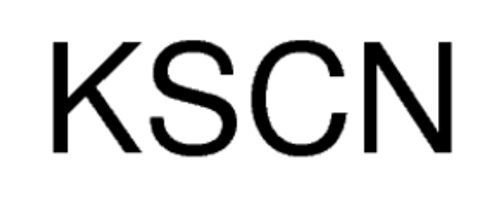
Potassium Thiocyanate 99% ACS 2.5 Kg
Synonym: Potassium rhodanide
- CAS Number 333-20-0
- Linear Formula KSCN
- Molecular Weight 97.18
- Beilstein/REAXYS Number 3594799
- EC Number 206-370-1
- MDL number MFCD00011413
- PubChem Substance ID 329752022
| Grade | ACS reagent |
| InChI Key | ZNNZYHKDIALBAK-UHFFFAOYSA-M |
| Assay | 99% |
| Impurities | Iodine consuming substances, passes test ≤0.005% insol. water |
| color | colorless to white |
| pH | 5.3-8.7 (25°C, 5%) |
| mp | 173°C (lit.) |
| anion traces | chloride (Cl-): ≤0.005% sulfate (SO42-): ≤0.005% |
| cation traces | Fe: ≤2 ppm NH4+: ≤0.003% Na: ≤0.005% heavy metals (as Pb): ≤5 ppm |
General description
Potassium thiocyanate is an inorganic potassium salt. Phase transitions in potassium thiocyanate (KSCN) have been investigated by X-ray diffraction studies. The order-disorder type transition with respect to the orientation of the thiocyanate ions was identified.[3] Its polarized infrared spectrum has been reported.[4] It participates in the ring-opening of aziridines. The reaction was carried out in the presence of sulfated zirconia to afford the corresponding β-aminothiocyanates.[5]
Application
Potassium thiocyanate (KSCN) may be used for the colorimetric quantification of intracellular iron content of the superparamagnetic iron oxide (SPIO) nanoparticles.[1]
Potassium thiocyanate may be used in the synthesis of the following:
α-Amino nitriles from tertiary amines.[6]
Polysubstituted 2-aminothiazoles from vinyl azides.[7]
Benzisothiazol-3(2H)-one derivatives from o-bromobenzamides.[8]
Diaryl thioethers from aryl halides.[9]
Safety Information
 GHS07
Signal word Warning
Hazard statements H302 + H312 + H332-H412
Precautionary statements P273-P280
Supplemental Hazard Statements Contact with acids liberates very toxic gas.
RIDADR NONH for all modes of transport
WGK Germany 1
RTECS XL1925000
Be the first to review “Potassium Thiocyanate 99% ACS 2.5 kg”
Related products


ACS Grade Chemicals
Sodium Carbonate ACS Reagent Anhydrous 99.95-100.05% Dry Basis 500 gram, case/6


Reviews
There are no reviews yet.